January 5, 2026
Nadiem’s Personal Objection: There Is Zero Evidence of Corruption
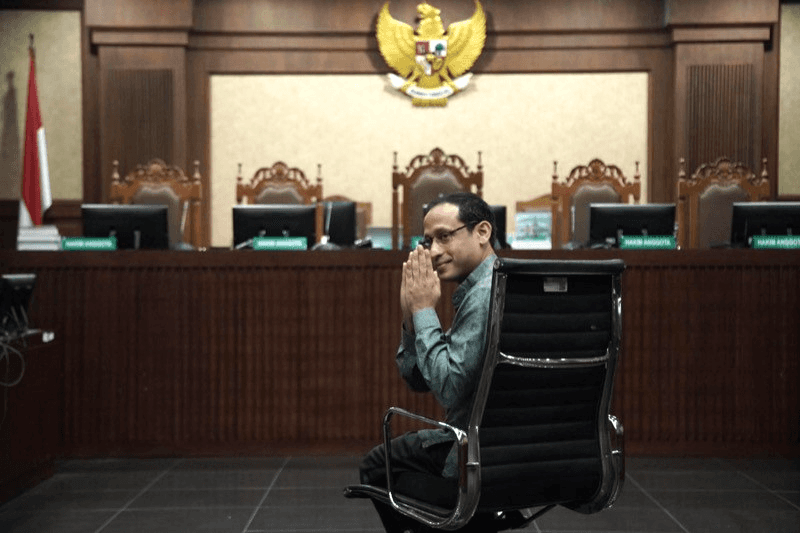
Nadiem’s objection states that the prosecutor’s indictment lacks clarity, having been drafted without valid evidence, in violation of criminal procedure, and potentially compromising the principles of justice.
Jakarta, January 5th 2026. During a continuation hearing in the alleged corruption case related to the Education Digitalization Program at the Jakarta Central Corruption Court, Nadiem Makarim submitted a Personal Objection (Eksepsi Pribadi) to the Public Prosecutor’s indictment, which he considers to be carelessly prepared, unclear, incomplete, and fundamentally failed to meet requirements stipulated under criminal procedural law.
In the objection presented before the Panel of Judges, Nadiem highlighted several key points, including:
At his request, in 2023 and 2024 the Financial and Development Supervisory Agency (BPKP) conducted two compliance audits of the Information and Communication Technology (ICT) Equipment Assistance Program for fiscal years 2020 and 2021-2022. The audits found no improper or unreasonable pricing, nor any violations that could result in potential state loss.
During Nadiem’s tenure as Minister, the Audit Board of the Republic of Indonesia (BPK RI) conducted audits of all activities at the Ministry of Education, Culture, Research, and Technology, including the Information and Communication Technology (ICT) Equipment Assistance Program for 2020–2022. All audit results from BPK RI recorded no violations that could potentially harm state finances.
Calculation of alleged state losses suddenly emerged in November 2025, AFTER Nadiem was named a suspect, based on a BPKP report. This stands in contrast to the two audits conducted by the same institution a year earlier. Moreover, the report did not receive a declaration from BPK RI, the sole institution constitutionally and legally authorized to determine state losses.
Alleged state losses amounting to IDR1.5 trillion, linked to the high price of laptops, is unrelated to the policy of Chrome OS usage instead of Windows OS, which in fact saved the state budget. Nadiem had no involvement in the procurement process, including price determination and vendor selection.
ICT Program procurement implementation was carried out with active guidance from the Attorney General’s Office, the Business Competition Supervisory Commission (KPPU), and the Government Goods/Services Procurement Policy Agency (LKPP), and was under the supervision of the Ministry of Education and Culture’s Inspectorate General, whose personnel have backgrounds in the Corruption Eradication Commission (KPK) and the Attorney General’s Office.
There is no concrete evidence supporting the charge of “enriching oneself”. The alleged IDR809 billion fund flow was purely a corporate transaction between PT Aplikasi Karya Anak Bangsa (PT AKAB) and PT Gojek Indonesia (PT GI), where Nadiem received zero amount of. These transactions can be easily verified through official documentation from PT AKAB (GoTo).
The increase in Nadiem’s assets, according to the State Officials’ Wealth Report (LHKPN), stems from fluctuations in the value of PT AKAB shares owned by Nadiem, detailed as follows:
2022: PT AKAB’s share price surged during its IPO to around IDR250–300 per share, with Nadiem’s wealth recorded at IDR4.8 trillion.
2023: PT AKAB’s share price fell to approximately IDR100 per share, and Nadiem’s wealth dropped sharply to IDR906 billion.
2024: PT AKAB’s share price declined further to around IDR70–80 per share, and Nadiem’s wealth decreased again to IDR600 billion.
When Chrome OS was selected in 2020, Nadiem did not sign any documents formalizing the decision. His role was limited to attending a meeting on 6 May 2020 and providing input on the Ministry team’s recommendation, which proposed an allocation of 14 Chrome OS laptops and 1 Windows laptop per school. Any subsequent changes to the final decision regarding Chrome OS usage were made without Nadiem’s input, as technical specifications determination was beyond his authority.
All facts show that the Chrome OS usage policy actually resulted in budget savings of at least IDR1.2 trillion. This is due to the fact that Chrome OS licenses are free, while Windows licenses are not.
The indictment is also considered to fail in explaining the causal link between alleged actions and purported state losses, even though corruption is a material offense that requires such consequences.
Nadiem further emphasized, “I cannot understand and strongly question how a BPKP audit result could exist without a declaration from BPK RI. BPK RI is the sole institution authorized to declare state losses. Why didn’t BPKP seek such a declaration from BPK RI?”.
Through this objection, Nadiem requested that the Panel of Judges dismiss the indictment, arguing that it was prepared without lawful evidence, contradicts criminal procedural law, and risks undermining the principles of justice.
Nadiem also stated that his entire life and career journey, both in building Gojek and in serving as Minister of Education and Culture, has been an effort to serve the nation with good intentions. He expressed hope that the Panel of Judges would deliver a decision that is as fair as possible, based on law and conscience.
Several public figures who attended the hearing expressed their support for Nadiem and highlighted the Personal Objection he presented.
“This case is not just about one individual, but about how the law is enforced. When charges are brought without valid evidence nor clear authority, what is truly being tested is the integrity of our judicial system,” said Goenawan Mohamad, a poet and senior journalist (Founder of Tempo).